Practice Low-Impact Lawn and Yard Care
Summary: Lawn and yard care recommendations related to mowing, watering, weeds and insects
Description
Maintaining a traditional lawn is one of the most environmentally harmful choices suburbanites make. Many homeowners don’t realize that the practices suburbanites have considered normal lawn care for decades are highly destructive to the environment, waste resources, and are a danger to human health.
Chemical fertilization and pesticides (both herbicides and insecticides) degrade soil, contaminate groundwater, harm microbial life, and have safety concerns. Producing chemical fertilizers has a large carbon footprint and fertilizer runoff causes water pollution. One study (Tufts 2013) reported that dogs living where there were professionally applied lawn pesticides had a 70% increase in cancer rate. Insecticides kill all insects and other arthropods. Organisms that help maintain healthy soil are killed as are beneficial predators of pest insects.
Powered lawn equipment is highly polluting. Lawn equipment is not manufactured to the pollution standards of motor vehicles. The gas-powered engines used in lawn equipment emit many times the pollution of cars. Most smaller devices like many string trimmers and leaf blowers utilize two-stroke engines that burn oil in their gasoline which produces an order of magnitude more pollution. Most people don’t realize how polluting these devices are. One study (Edmunds 2011) demonstrated that using a two-stroke leaf blower for one hour produced the same hydrocarbon emissions as driving a full-size pickup truck from Texas to Alaska. Further, high-powered leaf blowers can raise fine particulate matter that is a serious health threat. Many medical organizations have public statements warning of the dangers of particulate matter raised by leaf blowers.
Watering lawns uses more water than all other household activities combined.
Deep Dive
For a lawn replacement where you still want low-growing plants as a groundcover there are several options. One flowering plant to consider is wild strawberry. It’s hardy and can tolerate some foot traffic. Shorter native grasses like prairie dropseed can be used to maintain a grassy appearance that is somewhat taller than a mowed lawn. Many native sedges provide the same grassy look under one foot high, and many are shade tolerant. American cranberry is a wonderful evergreen groundcover and will grow in average soil. In a shady area with light sunlight where grass doesn’t like to grow, consider a moss-lawn. They are visually stunning and offer a welcoming, different look to traditional lawns. These are just a few examples. Do an internet search for lawn replacement plants; many resources are available.
Several native low-growing flowering plants work well mixed in a mowed lawn. Wild Violet, Lance-leaf Coreopsis, and Self-Heal (Prunella vulgaris) are a few options. You can skip mowing for a few weeks while they are blooming and then when needed, resume mowing. No-Mow May has become popular in recent years to allow flowering plants in lawns to provide early season nutrition for bees. It’s only of benefit if you have native flowering plants in your lawn including dandelions.
There are now lawn grass seed mixes that have been bred to grow slowly and either never need to be mowed or can be mowed just a few times a year. Two are Eco-Grass Low Maintenance Lawn Blend from prairiemoon.com and No Mow Lawn Seed Mix from prairienursury.com. This is not an endorsement of those products but provides an example of products that are now available.
Regarding watering, the very best thing you can do is just stop watering. Never water. Just be done with it. If your lawn is growing in a location that is appropriate for turf grasses, it may go dormant in a dry summer but will bounce back when it rains. If you have an area where the turf grass cannot survive a dry summer without regular watering, you should consider growing something else in that area. The green lawn tradition many suburbanites aspire to is based on the lawns of estates in Western Europe. We do not have the same climate. There are places where you just shouldn’t try to maintain a traditional lawn.
Another reason to skip watering is watering in early summer provides moisture that grubs need to grow. Japanese beetle eggs need moisture to grow into grubs. Watering in early summer can increase issues with grubs in your lawn.
If you must water, water efficiently. Water before 9:00AM or after 6:00 PM. Water infrequently but deeply so that grasses build deeper roots. If you have a sprinkler system, set it so that it doesn’t water when you have received natural rain. Also, adjust it so that water does not end up on pavement where it will simply evaporate. And remember to respect municipal water restrictions that may be in place during drought conditions.
To avoid the need for fertilizer, don’t bag clippings when you mow. Simply let the clippings decay which recycles nutrients to the lawn. Do not use a blower to blow clippings and chopped leaves off your lawn or if you hire a service, ask them to leave the fine debris on your lawn. It will naturally decay, fertilize your lawn, and add organic matter that will help retain moisture. You can leave a thin layer of leaves on your lawn or mulch leaves and leave them in place in fall. They will break down and add natural fertilizer. White clover, while not native, may be a welcome addition to your lawn as it naturally produces nitrogen providing fertilizer to the soil. Clover was popular in mid-20th century lawns prior to the introduction of broadleaf weed killers. Clover seed was often included in grass seed mix. You can buy white clover seed at garden centers or online and overseed your lawn. Clover also adds some drought tolerance to your lawn an micro-clovers are attractive, drought-resistant varieties.
Also, skipping chemical fertilizers will slow grass growth. That means less mowing and therefore less power equipment use.
Use of general insecticides on lawns is harmful to all life in your yard. Insecticides are non-selective and harm beneficial insects and other wildlife. Many of the lifeforms killed by insecticides are necessary to maintain healthy soil. Predator insects and spiders that normally control pest insects are killed. If you need grub control, you can try milky spore spray or introduce beneficial nematodes instead of using a general insecticide. Applying pesticides to vegetation like shrubs in an effort to control mosquitoes is mostly ineffective and harmful. The so-called organic solutions kill bees. Even when plants are not in bloom, they host beneficial insects like butterfly and moth caterpillars. These caterpillars are important food sources for birds raising their young. And those that live to adulthood are important pollinators.
The use of broadleaf weed killers have turned lawns into artificial monocultures that do not contribute to the environment. The best thing to do is just skip them. Allow other plants in your lawn. If you find certain weeds offensive, simply pull those by hand. If you must use chemicals to control certain weeds don’t spread the weed killer over your entire lawn. Use a hand sprayer and only spray the individual weeds.
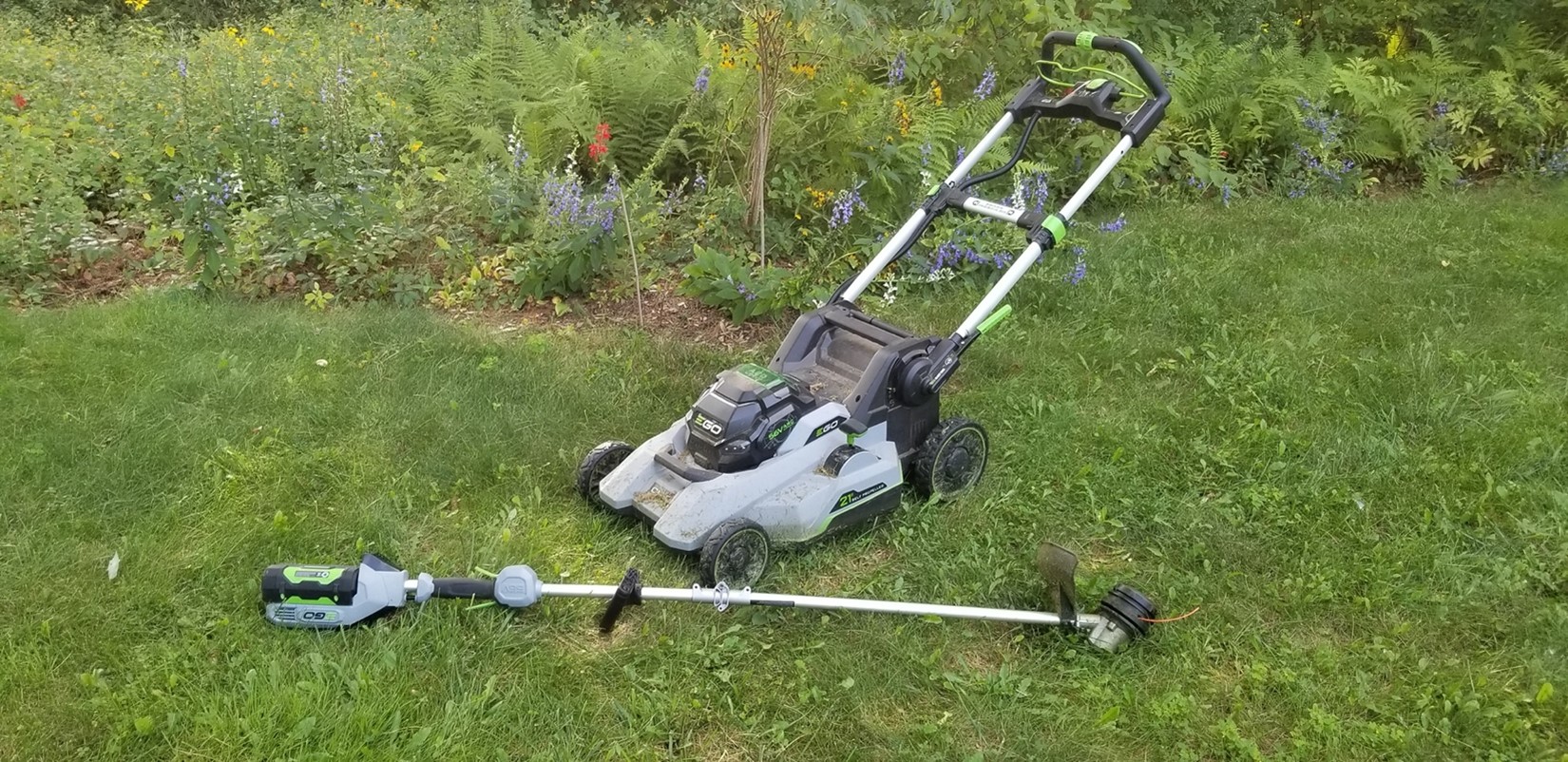
The best way to utilize power equipment is to use machines with the least impact that will do the job. Today’s electric mowers and string trimmers are now fully capable of maintaining the typical suburban lawn. If you do your own lawn care, consider buying electric equipment instead of gas-powered equipment. You’ll eliminate air pollution while doing your lawn work. You will also drastically reduce noise pollution. If you hire a service, look for a service that utilizes electric equipment.
There is no question that using gas-powered leaf blowers for general clean-up after mowing is harmful to human health, both to the operator and people in the area. The two-cycle engines that most leaf blowers employ emit dangerous emissions including carbon monoxide, nitrogen oxides, and volatile organic compounds. Of great concern is the impact of fine particulate matter that is raised by these machines. A wind in excess of 200MPH is expelled inches from the ground. Dust, dirt, pollen, fungal spores, animal feces, brake lining dust, and tire particles from cars can all be raised into the air. These particles are so fine that they linger for hours. The particles can lead to a variety of health problems, including respiratory issues such as exacerbating asthma, bronchitis, and allergies. Long-term exposure is associated with more serious health concerns, such as cardiovascular diseases and increased mortality rates.
The best thing to do is to skip the blower after mowing or ask your lawn service to skip using blowers to clean up after mowing. When using side-discharge mowers, mow in a direction such that the discharge is pointed toward the center of the lawn. For larger mowers, consider adding a gate on the chute that can be closed while turning the mower in an area where clippings could be expelled onto pavement. These steps will minimize the clippings that are spread onto the street, sidewalk, and driveway. If you can minimize clippings spread off of the lawn while mowing, there may be so few clippings you can just let them dry in place and eventually find their way back into the soil with the natural wind or rain. If you must clean up walks and pavement after mowing and you’ve minimized the clippings spread while mowing, a few minutes with a small handheld electric blower or broom can do the job. Again, use the least impactful equipment that will do the job.
More Resources …
Dangers of Lawn Chemicals
https://cfpub.epa.gov/npstbx/files/marc_lawnchemicals.pdf
Herbicides and Dog Cancer
https://www.humanesociety.org/news/dogs-lawn-care-and-cancer
https://pubmed.ncbi.nlm.nih.gov/23584031/
Quiet Communities
https://quietcommunities.org/quiet-landcare/
American Academy of Pediatrics on Gas-Powered Leaf blowers
https://quietcommunities.org/wp-content/uploads/2020/09/2020.06.01_AAP-Ch-2.pdf
Massachusetts Medical Society Policy on Gas-Powered Leaf Blowers
https://quietcommunities.org/wp-content/uploads/2020/09/MMS-GLP-policy-memo.pdf
Leaf blowers are not only annoying but also bad for you (and the environment)
https://www.zmescience.com/feature-post/technology-articles/sustainability/green-living-1/leaf-blowers-health-noise-hazards/
Fuel-powered Lawn Equipment Dangers
https://www.healthyyards.org/lbairquality/
http://ny2aap.org/2016/10/28/love-us-and-leaf-us-alone/
Lawn Impact and Replacement Video by Mark Richardson of Tower Hill Botanic Garden
https://www.youtube.com/watch?v=WRCA1jyx-hw
Carbon Footprint of Maintaining a Traditional Lawn
https://palebluedot.llc/carbon-copy/2015/7/16/the-carbon-footprint-of-a-lawn
Natural Lawn Care
https://www.ecofarmingdaily.com/eco-farming-index/natural-lawn-care/
Using a Zero-Turn Mower Minimizing the Need to Clean Up Clippings
https://www.youtube.com/watch?v=zAswQxp0o9g
Flowering Lawns
https://pollinators.msu.edu/sites/_pollinators/assets/File/Flowering%20Bee%20Lawns%20UMN.pdf
Home Grown National Parks
https://homegrownnationalpark.org/
Steps to Take
Minimize the area you maintain as a traditional lawn. Consider replacing areas that do not need to be turf grass with low-maintenance native plants and ground covers.
Consider your lawn a “mowed area” of plants short enough to walk on that may have a mixture of low-ground plants and not just 100% traditional turf grass. Mix in other short-growing plants and don’t worry if you have a few “weeds.”
When seeding a new area, consider one of the new low-mow/no-mow grass seed mixes. These need no water and need to be mowed at most once or twice a year.
Avoid watering your lawn. Allow your lawn to go dormant in the heat of summer and it will return in the fall. If you are going to water, adopted efficient watering practices.
Do not apply fertilizers, insecticides, or herbicides (broad leaf weed killer) to your lawn.
Use electric equipment, mowers, string-trimmers, etc. instead of gas-powered equipment.
Avoid using blowers for routine maintenance. If you must use a blower for fall-clean, use it only for fall cleanup.
Ask your mower to skip the blowers. If you hire a professional service, try to find one that utilize at least some electric equipment. Ask them to skip or minimize the last bit of clean up with the blowers. Often, they aren’t picking anything up with the blowers, they are simply blowing it into the air, so it drifts into a neighbor’s yard but poses a serious health thread while it is airborne.
Do less maintenance in general. Outside is always going to be a bit messy. Embrace a more natural look. Avoid the high cost of using a machine to blow off that last tiny bit of leaf off your lawn when another one will fall and replace it within the hour.
- All Actions